
Every birder who books with us asks the same question in the first email. When can I see a Harpy Eagle? It is a fair question, and one we take seriously, because we have watched enough people arrive in the wrong month to know how much a bit of planning matters. Cerro Azul is one of the more accessible places in Central America to reasonably hope for a Harpy sighting, but "reasonably hope" is doing a lot of work in that sentence. Here is what we actually tell guests.
The short answer: December through April
Panama's dry season runs from mid-December to late April, and this is prime time for Harpy Eagle observation at Cerro Azul. Two things line up in these months. First, trails are firm enough to reach the ridges and forest edges where the birds are seen. Second, and more important, active Harpy nests in the region are usually well established by January, and the adults are provisioning chicks through March and April. An active nest is the single strongest predictor of a sighting, because Harpy Eagles are ambush hunters that spend enormous stretches of time perched motionless. Without a nest to anchor them, one bird can range across 25 to 40 square kilometers of primary forest, and your chances of running into one on a random trail are close to zero.
May through November is the rainy season. Sightings still happen (we logged one in July 2024), but access to the deeper trails gets harder, cloud cover reduces visibility into the canopy, and the birds themselves range more widely once fledglings become independent.
Why Panama, and why Cerro Azul specifically
The Harpy Eagle (Harpia harpyja) is Panama's national bird. It is the largest raptor in the Americas by weight, with females reaching seven to nine kilograms and a wingspan just under two meters. They nest in the tallest emergent trees of intact lowland and premontane forest, favoring cuipo (Cavanillesia platanifolia) and ceiba. The nest itself is a platform of thick sticks, often 30 meters or more above the ground, and a breeding pair will reuse the same nest across multiple cycles.
Their diet is what makes finding them possible at all. Harpies hunt sloths and monkeys, primarily two-toed and three-toed sloths, howler monkeys, and capuchins. They are perch hunters, not soarers, so you find them by finding their nesting territory, not by scanning open sky. Cerro Azul sits at 700 to 900 meters elevation on the edge of Chagres National Park, where several documented territories overlap with forest that is still tall and connected. The Fundación Rapaces y Bosques de Panamá (Peregrine Fund's Panama program) has been tracking Harpy nests here and in the wider Darién for over two decades, and Cerro Azul is one of the few areas where a productive nest sits within a reasonable drive of Panama City.
What actually happens on a Harpy day
A realistic Harpy attempt from the lodge looks like this. We leave at 5:30 AM in the dark, because the drive to the trailhead takes about 40 minutes and you want to be at the observation point before the forest wakes up. Coffee in a thermos, breakfast packed. From the trailhead it is a 30 to 90 minute hike depending on which territory our guide is checking that week. Then you sit. Sometimes for two hours, sometimes for six. If a chick is on the nest, the adults typically deliver prey once every two or three days, which sounds terrible but actually improves your odds because a returning adult with a sloth in its talons is impossible to miss. If there is no chick and no fresh sign, our guide will move you to a secondary spot before midday.
We tell guests to plan two or three Harpy-focused mornings, not one. A single morning is a lottery ticket. Two or three mornings is a real shot. The best week we have had, a solo birder in February 2025 saw an adult female twice on a three-day booking, once at the nest and once carrying a howler monkey along a ridge.
What to bring, and what to expect emotionally
Binoculars are 8x42 minimum, a spotting scope is a real advantage for scanning the canopy, and camouflage or muted clothing helps. Bring water for six hours, snacks, and a small folding stool if your knees dislike sitting on roots. Wear boots that grip wet clay.
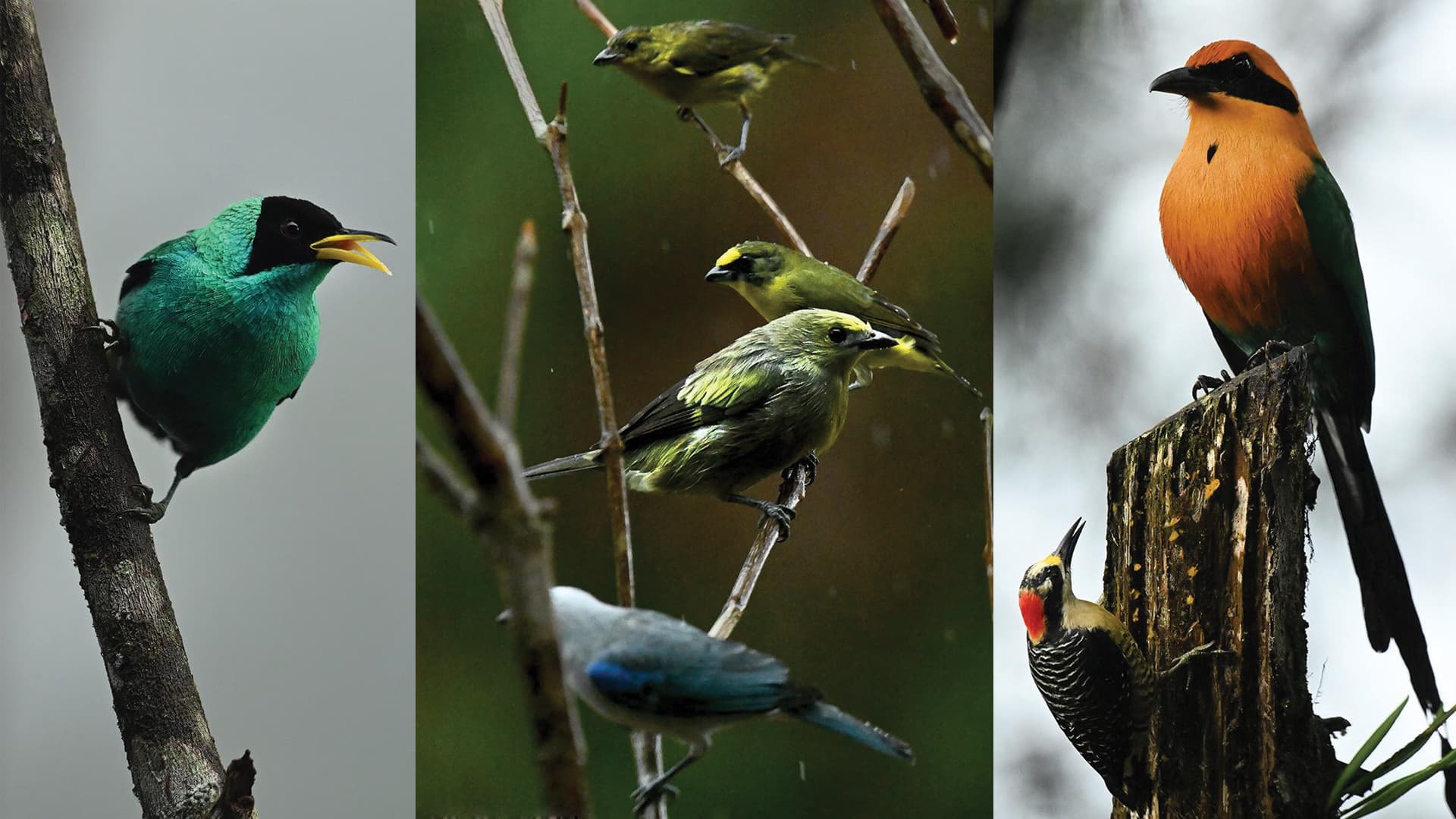
The emotional part is worth naming. Harpy Eagle watching is mostly sitting. If you are the kind of birder who wants a busy list and constant movement, the Harpy morning is not your favorite morning. It is a patience exercise punctuated by a possible five seconds that you will remember for the rest of your life. Guests who come in with that expectation tend to leave happier, whether they see the bird or not, because Cerro Azul offers 528 other species logged at the lodge, and any given "failed" Harpy sit produces motmots, tanagers, trogons, and often a Crested Guan or Great Tinamou.
The guides matter more than the season
The dry season improves your odds, but the person walking in front of you determines them. Our full-time VIP guide scouts the known territories weekly during the dry season, coordinates with local landowners and the Peregrine Fund staff when possible, and knows which nests are active in a given year (this changes annually because pairs rest between breeding cycles). This is not information you can get from eBird alerts or from arriving cold with a rental car. If a Harpy sighting is the reason you are coming to Panama, book a guide who is in that forest every week. That is true whether it is us or someone else.
Practical booking notes
Our Solo Birder King package is $575 per night all-inclusive, which includes the guide time, meals, and lodging. For a Harpy-focused trip we recommend a minimum of four nights, which gives you three usable mornings and one buffer day for weather or rest. February and March are our peak booking months, so if you want a dry-season slot, reach out three to five months ahead. WhatsApp us at +507 6767-9710 or email [email protected] and we will tell you honestly whether there is an active nest that season. If there is not, we will say so, and you can decide whether to come anyway for the other 500-plus species, or wait a year.
Cerro Azul is not a guarantee. It is a good bet, in the right months, with the right guide, and with the right expectations. That is the most honest thing we can say about looking for the largest eagle in the Americas.